A Clear 2026 Comparison to Help California Business Owners Understand Two Coverages
That Sound Similar but Protect Against Very Different Risks
Two of the most commonly confused insurance products among California business owners are general liability and professional liability. They sound similar, both are described as liability coverage, and both protect against lawsuits, so it is easy to assume one can substitute for the other. It cannot. These two coverages respond to fundamentally different types of claims, and confusing them is one of the more expensive mistakes a California business owner can make, often discovered only after a claim has already been filed. This guide breaks down exactly what each coverage protects against, which California businesses typically need which type, why many businesses end up needing both, and how to avoid the common misconception that a general liability policy alone satisfies every contractual insurance requirement.
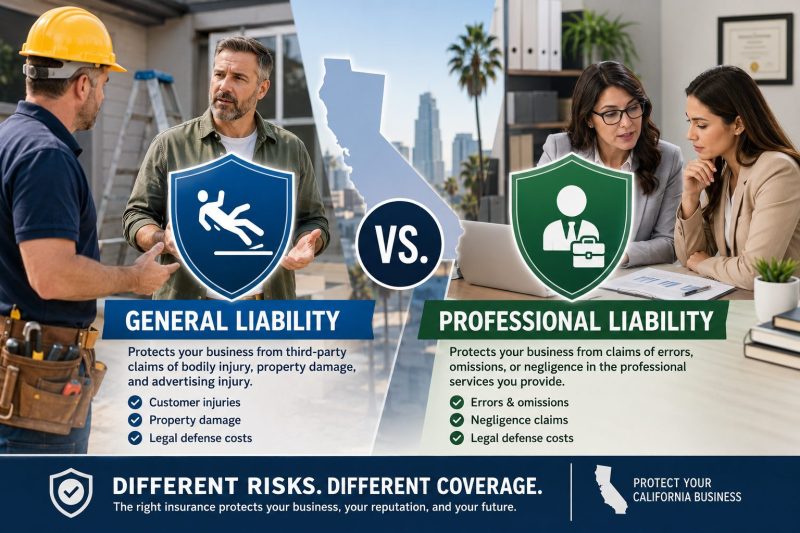
The short version: general liability protects against physical risks. Professional liability protects against risks tied to the quality, accuracy, or outcome of your professional work. The right answer for your business depends on how you operate, not on which policy sounds more comprehensive.
What General Liability Insurance Actually Covers
General liability insurance, sometimes called commercial general liability or CGL, protects your California business from common third-party claims tied to your everyday operations and physical premises. It is the coverage most small business owners carry first, because the risks it addresses are the ones nearly every business faces regardless of industry.
A standard general liability policy responds to bodily injury claims, such as a customer slipping and falling at your location. It covers property damage your business causes to someone else’s property, such as an employee accidentally damaging a client’s equipment during a service call. It also covers personal and advertising injury claims, including certain allegations of libel, slander, or copyright infringement tied to your marketing materials.
General liability is considered the foundation of a California business insurance program because it addresses risks that exist simply by operating a business with customers, vendors, or foot traffic. Retailers, restaurants, contractors, and any business that welcomes the public into a physical space rely on general liability as their first layer of protection.
What Professional Liability Insurance Actually Covers
Professional liability insurance, also known as errors and omissions coverage or E&O, protects your business against an entirely different category of claim. Instead of responding to physical accidents, it responds when a client alleges that your professional advice, service, or work product caused them financial harm.
This coverage addresses claims of negligence, where a client alleges you failed to perform your services to the expected standard. It addresses misrepresentation, covering claims that arise from incorrect or misleading information provided to a client. It also covers errors and omissions in the traditional sense, meaning mistakes or oversights in the professional work itself that result in a client’s financial loss.
Professional liability matters most for California businesses whose core offering is advice, expertise, or specialized service rather than a physical product. A financial advisor who recommends a strategy that leads to a client’s loss, a consultant whose analysis contains a material error, or a designer whose plans contain a flaw that causes downstream costs are all situations where general liability would not respond, but professional liability would.
Which California Businesses Need Which Coverage
Neither general liability nor professional liability insurance is universally required by California state law. However, both are frequently required in practice through leases, client contracts, and industry-specific expectations, which makes the distinction functionally important even without a direct legal mandate.
- Retail stores, restaurants, and businesses with foot traffic primarily need general liability to address premises injuries and property damage claims from customers and visitors.
- Consultants, technology firms, and advisory businesses primarily need professional liability, since their core exposure is tied to the advice or analysis they provide rather than physical premises risk.
- Contractors increasingly need both. General liability addresses jobsite injuries and property damage, while professional liability addresses design, coordination, or specification errors, an exposure that has grown as more contractors take on design-adjacent responsibilities using modern estimating and planning tools.
- Healthcare providers, real estate professionals, and financial advisors often need professional liability due to industry-specific regulatory expectations or licensing board requirements, in addition to general liability for any physical office exposure.
- Service businesses that visit client sites, such as landscapers, cleaners, and installers, primarily need general liability for property damage risk, with professional liability becoming relevant if the business also provides recommendations or specifications as part of the service.
A useful starting point for many California small businesses is a Business Owners Policy, which bundles general liability with commercial property and business interruption coverage. It does not include professional liability, which must be added separately or purchased as a standalone policy. For a full breakdown of what a BOP includes and excludes, see our guide on what a Business Owners Policy covers in California.
Why Many California Businesses Need Both Coverages
For a growing number of California businesses, the honest answer to which coverage is needed is both. Any business that combines direct interaction with the public or client property alongside specialized advice, design, or service work carries exposure on two separate fronts, and each requires its own coverage.
A contractor provides a clear example. General liability addresses a worker or visitor injured on a job site or damage to a client’s existing property during construction. Professional liability addresses a claim that a design recommendation, coordination decision, or specification error led to a costly problem after the work was completed. As design-build arrangements and technology-assisted planning have become more common in California construction, the line between jobsite accident and professional judgment has blurred, and insurers have responded with more explicit exclusions in general liability forms for anything resembling a professional services claim.
A useful test for evaluating your own business is to ask two separate questions. First, could someone be physically injured or have their property damaged because of how you operate? That points to general liability. Second, could a client claim that your advice, recommendation, or work product caused them financial loss, even without any physical accident involved? That points to professional liability. Many California businesses answer yes to both questions and should carry both coverages rather than treating one as a substitute for the other.
Our agents at Global Guard Insurance walk California business owners through both questions before recommending a coverage structure, because businesses that assume general liability alone provides comprehensive protection are often the ones most exposed when a professional services claim arrives. Reviewing your actual client contracts and lease agreements is the most reliable way to confirm exactly what coverage you are contractually required to carry, since a Certificate of Insurance alone does not guarantee your policies match every requirement.
Frequently Asked Questions
What is the difference between general liability and professional liability insurance in California?
General liability insurance protects your California business from third-party claims involving physical risks, including bodily injury, property damage, and advertising injury that occur during everyday operations. Professional liability insurance, also called errors and omissions coverage, protects your business when a client claims that your professional advice, service, or work caused them financial harm. General liability responds to physical accidents. Professional liability responds to claims about the quality or accuracy of your professional work.
Is general liability insurance required by law in California?
No. California does not universally require general liability insurance by state law. However, commercial landlords frequently require proof of general liability coverage as a condition of a lease, and many client contracts specify minimum liability limits as a condition of doing business. Certain industries and professional licensing boards may also require it as a practical matter, even when it is not a direct statutory mandate.
Which California businesses need professional liability insurance?
California businesses that provide advice, expertise, design work, or specialized services are the most likely to need professional liability insurance. This includes consultants, technology firms, healthcare providers, real estate professionals, financial advisors, designers, and contractors who take on design or coordination responsibilities. If a client could claim that your recommendation, service, or work product caused them financial loss, professional liability coverage is relevant to your business.
Can a California business need both general liability and professional liability insurance?
Yes, and for many California businesses, this is the more common outcome rather than the exception. A contractor may need general liability for jobsite injuries and property damage, along with professional liability for design or coordination errors. A consultant who meets clients at a physical office may need general liability for premises risk and professional liability for the advice they provide. Businesses that combine physical operations with expert services frequently carry both policies.
Does general liability insurance cover the cost of redoing my own defective work in California?
Usually not. General liability insurance may help cover resulting damage that your defective work causes to someone else’s property, but it typically does not pay to repair or redo your own faulty workmanship. This is a common misunderstanding among California business owners, and it is one of the reasons a Certificate of Insurance showing general liability alone does not guarantee every contractual coverage requirement has been satisfied.
Does a Certificate of Insurance prove a California business has adequate coverage?
Not entirely. A Certificate of Insurance only shows which policies are currently in place and at what limits. It does not guarantee those policies match every requirement in a specific contract. Many California contracts specifically require both general liability and professional liability coverage at defined limits. If a certificate does not reflect the required policy types, a business may be in breach of contract or lose a job despite carrying some form of coverage.
How much does professional liability insurance typically cost compared to general liability in California?
Professional liability insurance generally costs more than general liability for a comparable risk profile because claims involving professional judgment and financial harm tend to involve higher legal defense costs and more complex disputes than straightforward premises injury claims. The exact premium for either coverage depends on your industry, revenue, claims history, and the specific limits your contracts require. Get a free California business insurance quote, and our agents will compare general liability and professional liability options across multiple California carriers for your specific situation.
Get the Right Liability Coverage for Your California Business
Whether your business needs general liability, professional liability, or both, the licensed agents at Global Guard Insurance compare options across multiple California carriers to close the gaps that matter for your operations. Call (800) 750-9115 or get your free California business insurance quote today.