A Clear 2026 Guide to What a BOP Includes, What It Excludes, and Whether It Is the Right Foundation for Your California Business
Most California business owners discover they need commercial insurance the same way they discover they need an umbrella: right after the storm has already started. A customer slips near the register, a small fire damages the back office, or a burst pipe ruins a season of inventory, and suddenly the question of what your policy actually covers stops being theoretical. A Business Owners Policy, almost universally shortened to BOP, was built to prevent exactly that scramble. It bundles the handful of coverages that most small California businesses need into a single policy rather than requiring separate applications, separate renewals, and separate bills. This guide explains precisely what a BOP covers, what it deliberately leaves out, who qualifies for one in California, and how to know whether a standard BOP fits your business or whether you need something broader.
Understanding the shape of a BOP before you buy one prevents two common mistakes: assuming it covers more than it does, and adding costly endorsements for risks your business does not actually face.
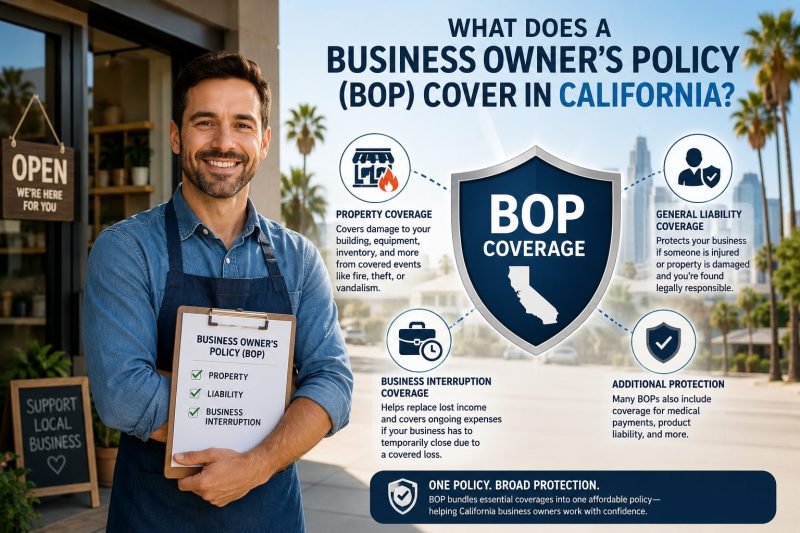
The Three Core Coverages Inside Every California BOP
A standard Business Owners Policy bundles three distinct types of coverage into one contract. Understanding each component separately makes it easier to see where the protection begins and ends.
Commercial property insurance protects the physical assets your business owns or is responsible for. This includes your building if you own it, along with equipment, furniture, fixtures, inventory, signage, and tenant improvements you have made to a leased space. Covered perils typically include fire, windstorms, hail, theft, vandalism, and certain types of water damage, though specific exclusions and limitations apply depending on the carrier and policy form.
General liability insurance protects your business if you are sued for harm or damage caused to a customer, vendor, or other third party. This includes bodily injury claims such as a customer slip and fall, property damage your operations cause to someone else’s property, and personal or advertising injury claims such as libel, slander, or copyright disputes. California’s litigation environment makes this component especially significant. A single injury claim that escalates into a lawsuit can generate legal defense costs alone that exceed what many small businesses could absorb without coverage in place.
Business interruption coverage, sometimes called business income coverage, reimburses your business for lost income and ongoing expenses such as rent, payroll, and utilities when a covered event forces you to suspend operations. If a fire closes your location for repairs, this component is what keeps the business financially stable during the shutdown rather than leaving the owner to cover fixed costs entirely out of pocket while no revenue is coming in.
What a Standard California BOP Does Not Cover
A BOP is broad for a small business package, but it has clear boundaries. Knowing what falls outside the standard policy is just as important as knowing what falls inside it.
- Workers compensation: California law requires nearly every employer with even one employee to carry workers compensation coverage, but it cannot be bundled directly into a BOP. It must be purchased as a separate policy.
- Commercial auto insurance: Vehicles owned by the business, including delivery vans and company cars, require a separate commercial auto policy. A BOP does not extend to vehicles.
- Professional liability or errors and omissions coverage: Claims arising from professional advice, services, or mistakes in your work product are not covered under a standard BOP and require a separate professional liability policy.
- Employee theft and dishonesty: Losses caused by an employee stealing from the business are generally excluded and require a fidelity bond or crime coverage endorsement.
- Flood and earthquake damage: Neither peril is included in a standard BOP. Given California’s seismic activity and increasing flood exposure in certain regions, business owners should evaluate both as potential separate coverages.
- Cyber liability: Data breaches, ransomware, and other cyber incidents are not covered by default and typically require a specific endorsement or standalone policy.
Business owners who assume a BOP is a complete insurance solution are often surprised at claim time to learn one of these exposures fell outside the policy. Reviewing your specific operations against this exclusion list before a loss occurs, rather than after, is the more effective approach. For California contractors in particular, several of these gaps, including commercial auto and specialized liability exposures, are common enough that we cover them in detail in our guide to business insurance for contractors in California.
Who Qualifies for a BOP in California
Most small to mid-sized California businesses with a physical location, moderate revenue, and a relatively straightforward risk profile qualify for a standard BOP. This includes retail stores, professional offices, restaurants and cafes, salons, medical and dental practices, consulting firms, and small service-based businesses.
A BOP is not the right fit for every business. Very small operations with minimal physical assets, such as a solo consultant working from home with no inventory or equipment, may only need a standalone general liability policy rather than the full bundle. Businesses that depend heavily on vehicles for their core operations may need commercial auto as their primary coverage rather than treating it as an afterthought. Larger businesses, or those with unusually complex or specialized risks, often outgrow the standard BOP form and benefit more from a Commercial Package Policy, which allows greater customization across a broader range of coverages.
Our agents at Global Guard Insurance regularly walk California business owners through this qualification question before recommending a policy structure, because purchasing a BOP that does not match the actual risk profile of the business, either too narrow or unnecessarily broad, creates problems that surface later rather than at the time of purchase.
Customizing a BOP With Endorsements
A standard BOP is a foundation, not a finished blueprint for every California business. Endorsements allow the base policy to be extended to address specific exposures that the standard form does not automatically include.
Cyber liability endorsements are increasingly relevant for California businesses that store customer information, process electronic payments, or rely on connected systems for daily operations. Equipment breakdown endorsements matter for businesses that depend on machinery, refrigeration, or specialized electrical systems, where a mechanical failure could otherwise fall into a coverage gap between property and liability. Hired and non-owned auto endorsements address situations where employees occasionally use their personal vehicles for business errands, a scenario that falls outside both personal auto policies and standard BOP coverage. Professional liability endorsements or standalone policies are relevant for any California business that provides advice, expertise, or professional services as part of its offering.
The most effective approach is to add endorsements to solve a specifically identified exposure in your business, not because a menu of add-on options exists. A bookkeeping office and a restaurant face genuinely different risks, and their BOP endorsements should reflect that difference rather than follow a one-size-fits-all checklist.
Frequently Asked Questions
What does a Business Owners Policy cover in California?
A standard California BOP bundles three core coverages: commercial property insurance for your building, equipment, inventory, and signage; general liability insurance for third-party bodily injury, property damage, and advertising injury claims; and business interruption coverage for lost income when a covered event forces a temporary shutdown. Together, these three coverages address the most common risks facing small and mid-sized California businesses in one bundled policy rather than requiring separate applications for each.
What does a BOP not cover in California?
A standard BOP does not include workers compensation, commercial auto insurance, professional liability or errors and omissions coverage, employee theft or dishonesty coverage, or damage from flood and earthquake. California businesses that need any of these protections must purchase them as separate policies or add specific endorsements where the carrier makes them available. A BOP is a foundational package, not a complete replacement for every type of commercial coverage a business may need.
Is a Business Owners Policy required by law in California?
No. California does not legally require businesses to carry a BOP. However, commercial landlords frequently require proof of general liability coverage as a condition of a lease, and lenders may require property coverage as a condition of financing. While not a state mandate, a BOP is often a practical necessity for operating a California business that leases commercial space or carries a business loan.
Which California businesses qualify for a Business Owners Policy?
Most small to mid-sized California businesses with a physical location, moderate revenue, and a relatively straightforward risk profile qualify for a BOP, including retail stores, professional offices, restaurants, salons, and medical or dental practices. Businesses with higher-risk operations, very large revenue, or highly specialized exposures may need a Commercial Package Policy instead, which allows broader customization than a standard BOP form provides.
Can I add workers compensation to my California BOP?
No. Workers compensation cannot be bundled directly into a BOP, and California law requires nearly every employer with even one employee to carry it as a separate policy. Many carriers that offer BOPs also offer workers compensation, and purchasing both from the same carrier may qualify a California business for a multi-policy discount even though the two remain separate policies. For a deeper look at California’s specific workers compensation requirements, see our guide to workers compensation insurance in California.
What endorsements are commonly added to a California BOP?
Common endorsements include cyber liability coverage for businesses that store customer data or process payments, equipment breakdown coverage for businesses that depend on machinery or refrigeration, hired and non-owned auto coverage for businesses whose employees occasionally drive for work purposes, and professional liability coverage for service-based businesses. Endorsements should be added to address a specific, identified exposure in your operations rather than purchased as a general precaution against every possible risk.
How does a BOP differ from a standalone general liability policy in California?
A standalone general liability policy only covers third-party bodily injury, property damage, and advertising injury claims. A BOP includes general liability as one component but also bundles commercial property insurance and business interruption coverage, protecting your physical assets and lost income in addition to your liability exposure. For most California businesses that own equipment, inventory, or lease a physical space, a BOP provides meaningfully broader protection than general liability alone, often at a lower combined cost than purchasing each coverage separately.
Get the Right Business Owners Policy for Your California Company
A well-structured BOP is the foundation of a smart insurance program for most California small businesses. The licensed agents at Global Guard Insurance compare BOP options across multiple California carriers to find the coverage and endorsements that actually match your operations. Call (800) 750-9115 or get your free California business insurance quote today