
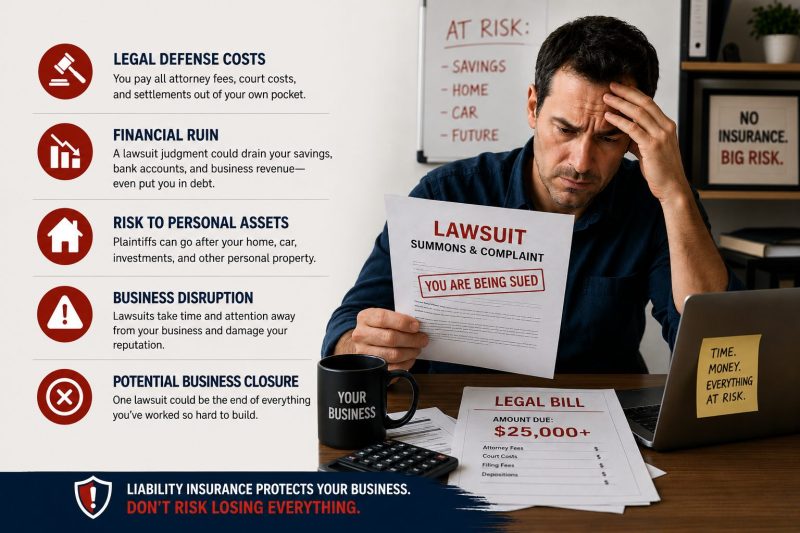
A Direct 2026 Look at What Is Actually at Risk, Including Your Personal Assets, When a California Business Lawsuit Arrives
Without Coverage in Place
A lawsuit is one of the most disruptive events a California business owner can face, and the anxiety intensifies considerably when there is no liability insurance standing between the claim and your finances. Depending on how your business is structured, a lawsuit without coverage in place can expose far more than the business itself, potentially reaching your personal savings, your home equity, and other assets you assumed were separate from your business’s risk. This guide explains exactly what happens in this situation, how your business structure changes the answer, and what steps to take immediately if you are already facing a claim without insurance in place.
The honest starting point is this: the absence of insurance does not reduce your legal exposure in any way. It simply means there is no policy funding your defense or absorbing a judgment, leaving that entire financial burden to fall directly on the business, and potentially on you personally.
Your Business Structure Determines How Much Is at Risk
How exposed your personal assets are in a lawsuit depends heavily on which legal structure your California business operates under. Understanding where your specific business falls is the first step in understanding your actual risk.
Sole Proprietorship
A sole proprietorship creates no legal separation between the owner and the business. If you are operating a business without having filed any formal business entity paperwork, you are very likely a sole proprietor, even if you did not intend to be. If a sole proprietorship is sued and loses, the owner’s personal assets, including a car, a home, and savings accounts, are directly exposed to satisfy the judgment.
General Partnership
A general partnership carries similarly significant exposure. All partners are generally personally liable for the business’s debts and legal judgments, and a partner can be held responsible for the full amount of a judgment even when the underlying issue arose from another partner’s actions. Formal partnership agreements addressing liability allocation are strongly advised for any California business with more than one owner.
Limited Liability Company (LLC)
An LLC creates what is commonly called a corporate veil, a legal separation between the business’s liabilities and the owner’s personal assets. When a properly maintained LLC is sued, only the business’s own assets are typically at risk, not the owner’s personal property. This protection is conditional and depends on the business being operated as a genuinely separate entity, as covered in detail below.
Corporation
A corporation offers a similarly strong liability shield for its owners, referred to as shareholders in this structure. Under California Corporations Code Section 200, a corporation is treated as its own distinct legal entity. When the corporation enters into a contract, incurs a debt, or is sued for a defective product or service, the shareholders’ personal assets are generally shielded to the extent of what they invested in the company, provided the corporate structure has been properly maintained.
When the Corporate Veil Fails to Protect You
Forming an LLC or corporation is the right move for asset protection, but that protection is not automatic or guaranteed. California courts have the authority to look past your business entity and hold you personally responsible through a legal doctrine called piercing the corporate veil, sometimes referred to as alter ego liability.
California courts apply a two-part test when evaluating whether to pierce the corporate veil. First, they examine whether there is such a significant unity of interest and ownership between you and the business that the two have effectively ceased to exist as separate entities. Second, they evaluate whether allowing you to hide behind the business structure would produce an unfair or fraudulent result for the party suing you.
Several common practices increase the risk of a California court piercing the corporate veil: commingling personal and business funds, undercapitalizing the business relative to its risks, ignoring basic corporate formalities such as required meetings or documentation, and treating business assets as personal property. None of these requires fraudulent intent to trigger veil piercing. An honest business owner who has simply been informal about separating finances can lose the protection they assumed their LLC provided.
Employee Lawsuits Can Reach You Personally Even With a Proper LLC
A particularly important and often overlooked California-specific risk applies even to business owners who have maintained their LLC or corporation correctly. California Labor Code Section 558.1 allows an employee to name a business owner or managing agent personally in certain wage and hour violation lawsuits, entirely separate from the traditional corporate veil framework. This means proper LLC maintenance does not fully shield an owner from every category of claim.
This risk is compounded by California’s Private Attorneys General Act, commonly called PAGA, which allows a single employee to file a lawsuit on behalf of the state seeking penalties for Labor Code violations affecting the entire current and former workforce, not just the individual who filed the claim. Combined with Section 558.1’s personal liability provision, this creates meaningful exposure for California business owners around payroll and worker classification practices, regardless of how well the underlying business entity has been maintained.
What No Insurance Actually Means in Practice
Without liability insurance, every dollar spent defending a lawsuit, from attorney fees to expert witnesses to court costs, comes directly out of the business’s cash flow or the owner’s personal funds. If the claim is not successfully defended, any settlement or judgment must similarly be paid without an insurance policy absorbing that cost. For a business with limited cash reserves, legal defense costs alone, well before any settlement or judgment is reached, can be enough to threaten the business’s ongoing operations.
General liability insurance is specifically designed to fund exactly this scenario: legal defense costs, settlements, and judgments arising from third-party bodily injury, property damage, and related claims. A Business Owners Policy, which bundles general liability with commercial property and business interruption coverage, is the starting point most California small businesses use to establish this protection. Our guide on what a Business Owners Policy covers in California breaks down exactly what that coverage includes and where its limits are.
Our agents at Global Guard Insurance consistently emphasize to California business owners that entity structure and insurance are not substitutes for one another. They work together. An LLC or corporation provides a layer of legal separation for many claim types, while liability insurance funds the actual costs of defending and resolving a covered claim regardless of how the business is structured. Relying on only one of these protections leaves a meaningful gap in either direction.
What to Do Right Now If You Are Facing a Claim Without Coverage
If you have already been served with a lawsuit and have no liability insurance in place, contact a business litigation attorney immediately. California lawsuits carry strict and limited response deadlines, and failing to respond within that window can result in a default judgment against you. An attorney can review the specifics of how your business is structured and operated, assess your actual exposure, and help build a defense strategy for both the business and, if necessary, you personally.
If you have not yet been sued but recognize you are currently operating without coverage, addressing that gap now, before a claim arises, is significantly more effective than trying to secure coverage after a lawsuit has already been filed. Insurance cannot be purchased retroactively to cover a claim that already exists.
Frequently Asked Questions
What happens if my California business is sued and I have no liability insurance?
Without liability insurance, your business alone is responsible for paying legal defense costs, settlements, and any court judgment out of pocket. Depending on how your business is structured, this exposure may extend beyond the business itself to your personal assets, including savings, home equity, and other property. The absence of insurance does not reduce your legal exposure. It simply means there is no policy standing between the claim and your finances.
Does an LLC protect my personal assets if my California business is sued?
An LLC generally creates a legal separation, often called a corporate veil, between the business’s liabilities and the owner’s personal assets, provided the business is run and maintained correctly. However, this protection is not absolute. California courts can pierce the corporate veil and hold an LLC owner personally liable if the business was not properly maintained as a separate entity, was undercapitalized, or if the owner personally participated in the wrongdoing at issue in the lawsuit.
Are sole proprietors personally liable if their California business is sued?
Yes, entirely. A sole proprietorship creates no legal separation between the owner and the business. If a sole proprietorship is sued and loses, the owner’s personal assets, including a car, home, and savings accounts, are directly at risk to satisfy the judgment. This is one of the most significant reasons sole proprietors in California are strongly advised to carry liability insurance regardless of the size or perceived risk level of their business.
Can a California LLC owner still be personally sued for employee claims even without piercing the corporate veil?
Yes. California law includes specific statutes, most notably Labor Code Section 558.1, that allow an employee to name a business owner or managing agent personally in certain wage and hour violation claims, separate from the traditional corporate veil framework. This means an LLC or corporation does not fully shield an owner from personal liability in every type of claim, particularly employment-related violations, regardless of how well the business entity itself is maintained.
What is the corporate veil and when can it be pierced in California?
The corporate veil is the legal separation between a business entity, such as an LLC or corporation, and its individual owners, which normally shields personal assets from business liabilities. California courts can pierce this veil, exposing personal assets, when there is significant unity of interest between the owner and the business such that the two have effectively ceased to be separate, and when maintaining that separation would produce an unfair result. Common triggers include commingling funds, undercapitalization, and failing to follow corporate formalities.
Is liability insurance a substitute for forming an LLC in California, or do I need both?
You generally need both. Forming an LLC or corporation and carrying liability insurance serve different purposes and work together rather than substituting for one another. The business entity structure provides a layer of legal separation for many types of claims, while liability insurance funds the actual defense costs and settlements when a covered claim arises, regardless of your business structure. Get a free California business insurance quote to close this gap before a claim arrives.
What should a California business owner do immediately after being served with a lawsuit and having no insurance?
Contact a business litigation attorney immediately, since California lawsuits carry strict and limited response deadlines. Do not ignore the lawsuit or attempt to handle it without legal counsel. An attorney can evaluate your actual exposure based on how your business is structured and operated, and help determine the best strategy for defending both the business and, if necessary, the individual owner personally.
Close Your Liability Gap Before a Claim Arrives
Insurance cannot be purchased after a lawsuit is already filed. The licensed agents at Global Guard Insurance help California business owners put the right liability coverage in place before it is needed. Call (800) 750-9115 or get your free California business insurance quote today.