
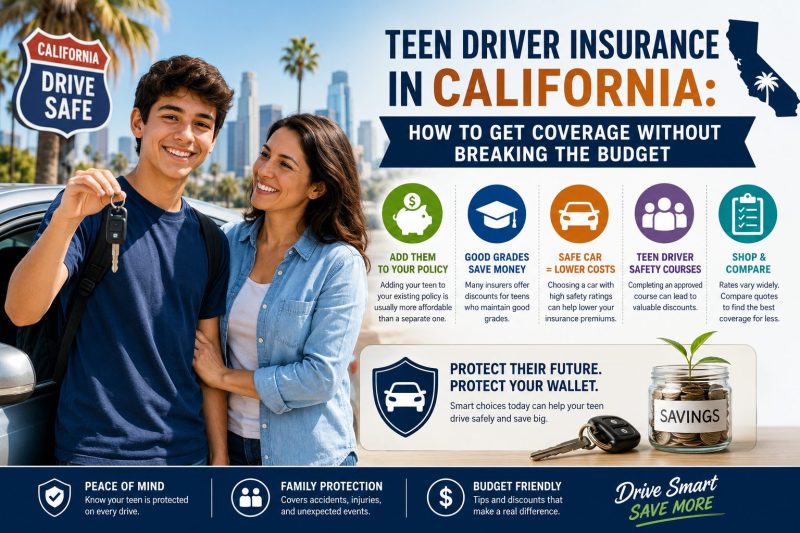
A Practical 2026 Guide for California Parents Through the Graduated Driver License Program, Insurance Timing, and the Discounts That Actually Move the Needle
The moment a California parent learns their teenager is ready for a provisional license is often followed almost immediately by a very different kind of anxiety: what this is going to do to the family’s car insurance bill. The concern is legitimate. Teen drivers are statistically the highest-risk category on the road, and insurers price that risk accordingly. But the situation is more manageable than it first appears, particularly in California, where specific state rules create real opportunities to reduce the added cost if you understand how to use them. This guide walks through exactly when your teen needs to be added to your policy, why keeping them on a family policy is almost always cheaper than a separate one, how California’s graduated licensing system intersects with insurance pricing, and which discounts are worth pursuing immediately.
Every family’s exact premium impact will differ based on the vehicle, coverage level, and carrier, but the strategies below apply broadly across California households adding a new teen driver.
California's Graduated Driver License Program and What It Means for Insurance
California uses a three-stage Graduated Driver License program, commonly called GDL, that directly affects when your teen needs to be added to your policy and how their driving privileges are restricted along the way.
Stage one is the learner’s permit, available starting at fifteen and a half. During this stage, your teen must always be accompanied by a licensed adult and is generally covered under that adult’s existing auto policy without requiring a separate premium, since they cannot legally drive alone. This stage requires completing fifty hours of supervised driving practice, including ten hours at night, along with driver education coursework, before the teen becomes eligible for a provisional license.
Stage two is the provisional license, available at sixteen after holding a permit for at least six months. This is the point where your teen can drive unsupervised, and it is also the point where they must be added to your auto policy as a listed driver. California’s provisional license carries two significant restrictions during the first twelve months: no unsupervised driving between eleven at night and five in the morning, except for work, school, or medical necessity, and no transporting passengers under twenty unless a licensed adult twenty-five or older is also in the vehicle.
Stage three is the full unrestricted license, available at eighteen or after twelve months on a provisional license, whichever comes later. Your premium does not automatically decrease the moment your teen reaches this stage. Age and accumulated driving experience remain the primary rating factors, not the specific license stage itself, so most families see rates gradually decline year over year as their teen ages and maintains a clean record, rather than dropping sharply at any single milestone.
Timing Matters More Than Most Parents Realize
One of the most common and costly mistakes California parents make is mistiming when they add their teen to the policy. Adding a teen the moment they receive a learner’s permit means paying months of increased premiums for a driver who can only legally operate the vehicle under direct adult supervision.
The opposite mistake, waiting until after the provisional license is already issued, creates a genuine coverage gap risk. Once your teen holds a provisional license, they are legally permitted to drive unsupervised, and if they are not yet listed on your policy, any accident during that window could result in a claims denial.
The correct approach is adding your teen to the policy in the weeks immediately before their provisional license road test, so coverage is active the moment they are legally able to drive alone, without paying for months of unnecessary premium during the permit-only supervised stage.
Adding Your Teen to Your Policy vs. a Separate Policy
For the overwhelming majority of California families, adding a teen driver to an existing household auto policy costs meaningfully less than purchasing the teen a standalone policy. This is because insurers evaluate a listed teen driver against the household’s overall risk profile, driving history, and multi-vehicle discounts, rather than underwriting the teen in isolation with no driving history of their own to draw on.
A separate policy for a teen driver also forfeits any multi-car or multi-policy discounts the family may already have in place, and it requires the teen to build an entirely independent insurance and claims history from scratch. Unless there is a specific reason for separate coverage, such as the teen owning their own vehicle outright and living independently, keeping them on the family policy is almost always the more cost-effective path.
Beyond the decision of whether to add your teen versus insuring them separately, there are several additional strategies that can meaningfully reduce the overall household premium after your teen is added. Our guide on how to lower your car insurance rates in California covers broader strategies that apply to the whole household, several of which compound well with the teen-specific discounts below.
Discounts California Parents Should Ask About Immediately
Several discounts exist specifically to reduce the cost of insuring a new teen driver in California, and one of them is a legal requirement rather than a discretionary offer.
- Good student discount: California Insurance Code Section 1861.02 legally requires all auto insurers in the state to offer this discount to drivers under twenty-five who maintain at least a B average. This is not optional for the insurer to provide if your teen qualifies, though you must submit proof, typically a report card or transcript, and renew that proof periodically.
- Driver training discount: Completing an approved driver education and behind-the-wheel training program, which California already requires for provisional license applicants under seventeen and a half, often qualifies for an additional carrier discount on top of satisfying the licensing requirement itself.
- Multi-car discount: Households with more than one insured vehicle typically receive a discount across all vehicles on the policy, including the one your teen primarily drives.
- Multi-policy discount: Bundling your auto policy with a renters or homeowners policy through the same carrier frequently produces a meaningful discount across both policies.
- Away-at-school discount: If your teen attends college a significant distance from the family vehicle and does not have regular access to a car, some carriers offer a reduced rate to reflect the lower driving exposure.
Our agents at Global Guard Insurance walk California families through every discount their teen may qualify for before finalizing a policy, since these discounts are rarely applied automatically and often require the parent to specifically ask and provide documentation.
Setting Coverage Levels for a New Teen Driver
Many California parents instinctively want to reduce coverage levels to offset the cost of adding a teen driver. This approach requires real caution. Teen drivers, precisely because they are higher risk, benefit the most from adequate liability limits and uninsured motorist coverage, since they are statistically more likely to be involved in an accident during their first several years of driving.
Rather than reducing coverage limits, focus cost-management efforts on the discount strategies above, and consider your deductible level on collision and comprehensive coverage for the vehicle your teen primarily drives. A higher deductible on an older vehicle can meaningfully reduce premiums while keeping your liability protection intact.
Frequently Asked Questions
When does a California teen driver need their own insurance coverage?
A California teen driver does not need separate insurance while holding only a learner’s permit, since they must always drive with a licensed adult present and are typically covered under that adult’s existing policy. Once your teen receives a provisional license and can drive unsupervised, they must be added as a listed driver on a household auto policy. The correct timing is adding your teen shortly before their provisional license driving test, rather than the moment they first receive a permit.
Is it cheaper to add a teen to a parent's policy or buy them a separate policy in California?
For nearly all California families, adding a teen driver to a parent’s existing auto policy is significantly less expensive than purchasing a separate policy for the teen. Insurers generally price a listed teen driver against the household’s overall risk profile and driving history, which produces a lower combined rate than underwriting a brand-new teen driver as a standalone policyholder with no driving history of their own.
What is California's Graduated Driver License program and how does it affect insurance?
California’s Graduated Driver License, or GDL, program has three stages: a learner’s permit available at fifteen and a half, a provisional license available at sixteen after holding a permit for at least six months, and a full unrestricted license available at eighteen or after twelve months on a provisional license. During the provisional stage, teens face nighttime driving restrictions and passenger limits. These restrictions reduce exposure during the highest-risk driving conditions, which some California insurers factor into how they price provisional teen drivers.
Does California require insurers to offer a good student discount for teen drivers?
Yes. California Insurance Code Section 1861.02 requires all auto insurers doing business in the state to offer a good student discount to drivers under twenty-five who maintain at least a B average or equivalent standing. This is a legal requirement, not a discretionary offer, and it typically requires submitting a current transcript or report card to your insurer, with renewed proof required periodically to maintain the discount.
Are usage-based or telematics insurance discounts available for California teen drivers?
Widely advertised telematics programs that track driving behavior in real time through a mobile app or device, common in many other states, are not broadly available in California in the same form due to the state’s regulatory framework under Proposition 103. Some limited usage-based programs exist, but California teen drivers should not assume the telematics discounts they see advertised nationally will be available from every carrier operating in the state.
What discounts are available for teen drivers in California besides the good student discount?
Beyond the legally required good student discount, California teen drivers may qualify for a driver training discount for completing an approved driver education and behind-the-wheel training program, a multi-car discount for households with more than one insured vehicle, a multi-policy discount for bundling auto with another policy such as renters or homeowners, and an away-at-school discount if the teen attends college a significant distance from the family vehicle.
Do California's provisional license restrictions lower a teen's insurance rate?
California’s provisional license restrictions, including the nighttime driving curfew and passenger limits during the first twelve months of licensure, are not a direct or guaranteed rate reduction, since insurers price primarily based on age and driving history rather than license stage alone. However, some carriers do consider the reduced exposure hours these restrictions create as a favorable factor. A violation of these restrictions can remain on a teen’s driving record and negatively affect rates for several years. Contact Global Guard Insurance to compare teen driver options across multiple California carriers.
Get Affordable Teen Driver Coverage in California
Adding a teen driver does not have to blow up your family’s budget. The licensed agents at Global Guard Insurance compare options across multiple California carriers and apply every discount your teen qualifies for. Call (800) 750-9115 or get your free California auto insurance quote today.