A Clear 2026 Breakdown of Which Natural Disasters Your Renters Policy Actually Protects Against, and Which Ones Require Separate Coverage
California renters face two of the state’s most significant natural disaster risks, wildfire and earthquake, and the honest answer to whether renters insurance covers each one is genuinely different for both. This distinction matters enormously and is frequently misunderstood. Confusing the two, or assuming a single policy handles both risks identically, is exactly the kind of gap that leaves California renters financially exposed after a real loss. This guide explains precisely what your standard renters policy covers when it comes to wildfire, what it does not cover regarding earthquakes, and what separate coverage exists to close that specific gap.
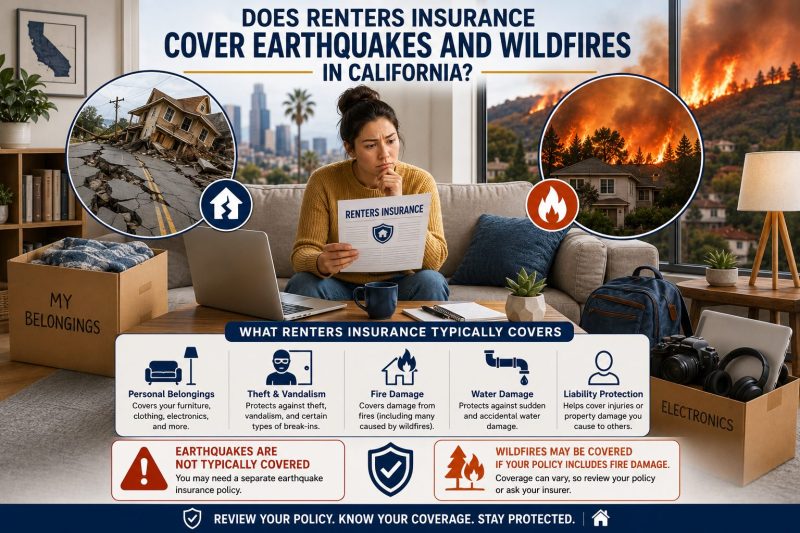
The short version, stated clearly upfront: wildfire-related fire and smoke damage is covered under a standard renters policy. Earthquake damage is not, and never has been, covered under any standard renters or homeowners form in California.
Wildfire Coverage: What Your Renters Policy Actually Includes
Fire and smoke are standard named perils under every California renters insurance policy. This means wildfire-related damage to your personal belongings, whether from direct fire contact or smoke infiltration, is a covered loss under your policy’s personal property coverage, subject to your chosen coverage limit and deductible.
This coverage extends beyond direct fire damage in a way that surprises many California renters. Smoke damage is treated as its own covered peril, separate from direct flame contact. If wildfire smoke infiltrates your rental unit and damages furniture, electronics, clothing, or other belongings, or if professional smoke remediation is needed to make the unit livable again, this is generally recognized as a legitimate covered loss, even in situations where the fire itself never physically reached your building. Given how far wildfire smoke can travel across California and how significantly it can affect air quality and interior surfaces at a considerable distance from the actual fire, this distinction matters a great deal.
If a wildfire renders your rental unit uninhabitable, your policy’s additional living expense coverage, sometimes called loss of use coverage, applies to pay for temporary housing and related costs while the unit is repaired or you find alternative accommodations. California law requires insurers to offer additional living expense coverage for a minimum period of at least 36 months following a covered total loss under specific disaster circumstances, though your specific policy’s own dollar and time limits as stated on your declarations page govern most individual claims. For a full breakdown of the core coverages every California renter should understand, see our guide on why every California renter needs renters insurance.
Earthquake Coverage: The Gap Every California Renter Should Know About
Here is where the coverage picture changes entirely. Standard renters insurance policies in California exclude earthquake damage as a matter of course, exactly the same way standard homeowners policies do. No standard renters form includes earthquake protection by default, regardless of which carrier issues the policy.
This means that if an earthquake damages or destroys your personal belongings, your standard renters policy will not respond to that claim. Given California’s extensive network of active fault lines and the scientific consensus that a major earthquake affecting populated areas of the state is a matter of when rather than if, this is a meaningful gap for renters to understand and evaluate deliberately rather than discover after a loss.
Earthquake coverage for renters is available separately, most commonly through the California Earthquake Authority, the same publicly managed, privately funded organization that provides earthquake coverage to homeowners. A CEA renters policy covers your personal property if it is damaged in a qualifying earthquake and provides additional living expense coverage if your unit becomes uninhabitable as a result. It does not cover the building structure itself, since that remains the landlord’s responsibility under their own property insurance, not the tenant’s.
One point worth noting for renters specifically: because a CEA renters policy only needs to cover personal belongings and displacement costs rather than an entire dwelling structure, it is generally significantly more affordable than the equivalent homeowners earthquake policy, making it a more accessible add-on for tenants who want this specific protection.
California’s history of significant seismic events, combined with the scientific projection that a major earthquake affecting populated portions of the state is highly likely within the coming decades, is why insurance professionals consistently recommend that renters evaluate this coverage deliberately rather than assume it comes bundled with a standard policy.
Why These Two Perils Require Completely Separate Decisions
Wildfire and earthquake are frequently discussed together as California’s two defining natural disaster risks, but from an insurance standpoint, they could not be more different. Wildfire coverage already exists inside your standard renters policy. Earthquake coverage does not exist anywhere inside a standard policy and must be actively added as a separate purchase.
This means California renters do not face a single decision about natural disaster coverage. They face two entirely separate ones. The first, wildfire protection, is already handled as long as you carry a renters policy at all, though it is worth confirming your personal property limit and additional living expense limit are set high enough to reflect current replacement costs and local housing costs during a potential displacement. The second, earthquake protection, requires an active decision to add a CEA policy or equivalent endorsement, and doing nothing means going without that specific coverage entirely.
Our agents at Global Guard Insurance regularly walk California renters through this exact distinction, since the assumption that one policy or one add-on handles both risks is one of the most common misunderstandings we encounter. Renters in areas with both meaningful wildfire exposure and proximity to active fault systems, which describes a significant portion of California, should evaluate the earthquake decision independently rather than assuming their standard policy already addresses it.
What About Flood Damage?
For completeness, it is worth noting that flood damage follows the same exclusion pattern as earthquake. Standard renters insurance does not cover flood damage to personal belongings. Flood coverage must be purchased separately, typically through the National Flood Insurance Program or a private flood insurer. California renters in areas with meaningful flood risk, including those near waterways or in regions that have experienced non-traditional flooding events in recent years, should evaluate this third coverage gap alongside the earthquake decision, since all three perils, wildfire, earthquake, and flood, are treated as entirely distinct risks requiring their own specific coverage path.
The practical takeaway for California renters is straightforward. Do not assume that carrying a renters policy means every major disaster risk in the state is automatically addressed. Wildfire protection is already built in. Earthquake and flood protection are not included, and both require an active decision and a separate purchase. Reviewing your specific location’s exposure to each of these three perils individually, rather than treating them as a single bundled risk, is the only reliable way to know where your actual coverage gaps sit.
Frequently Asked Questions
Does renters insurance cover wildfire damage in California?
Yes. Fire and smoke are standard covered perils under a California renters insurance policy, and this includes damage caused by wildfires. If a wildfire damages or destroys your personal belongings, or forces you to evacuate and your rental unit becomes uninhabitable, your renters policy’s personal property and additional living expense coverage both apply, subject to your policy limits.
Does renters insurance cover earthquake damage in California?
No. Standard renters insurance policies in California exclude earthquake damage, the same as standard homeowners policies. California renters who want protection against earthquake damage to their personal belongings must purchase a separate earthquake policy or endorsement, most commonly available through the California Earthquake Authority, which offers earthquake coverage specifically designed for renters in addition to homeowners.
What does the California Earthquake Authority renters policy cover?
A CEA renters earthquake policy covers personal property damaged by a qualifying earthquake and additional living expenses if the rental unit becomes uninhabitable as a result. It does not cover the building structure itself, since that remains the landlord’s responsibility to insure. CEA renters policies are generally more affordable than homeowners earthquake policies, since they do not need to insure a dwelling structure, only the tenant’s personal belongings and displacement costs.
Does renters insurance cover wildfire smoke damage even if the fire never reaches my building in California?
Yes, in most cases. Smoke damage is a standard covered peril under renters insurance, separate from direct fire damage. If wildfire smoke infiltrates your rental unit and damages furniture, electronics, or other belongings, or requires professional smoke remediation, this is generally treated as a legitimate covered loss under your personal property coverage, even if the fire itself never physically reached your building.
How long does California require renters insurance to pay additional living expenses after a wildfire?
California law requires insurers to offer additional living expense coverage for a minimum period of at least 36 months following a covered total loss in specific disaster circumstances. However, most standard renters policies carry their own specific dollar and time limits for additional living expenses as stated on the declarations page, so renters should review their specific policy limits rather than assume the full legal minimum automatically applies to every claim.
Should California renters in wildfire-prone areas buy earthquake coverage too?
It depends on the specific seismic risk of the renter’s location, which is a separate consideration from wildfire risk. Many areas of California carry both meaningful wildfire exposure and proximity to active fault systems. Renters in these overlapping risk areas should evaluate earthquake coverage independently from their standard renters policy’s wildfire and fire protection, since the two perils require entirely separate coverage decisions.
Does renters insurance cover flood damage in California?
No. Standard renters insurance excludes flood damage, similar to the earthquake exclusion. Flood coverage for a renter’s personal property must be purchased separately, typically through the National Flood Insurance Program or a private flood insurer. This is a distinct peril from wildfire and earthquake. Contact Global Guard Insurance to review which of these coverages make sense for your specific location.
Know Exactly What Your California Renters Policy Covers
Wildfire is covered. Earthquake is not, unless you add it. The licensed agents at Global Guard Insurance can walk you through exactly what your renters policy includes and where the gaps are. Call (800) 750-9115 or get your free California renters insurance quote today.