
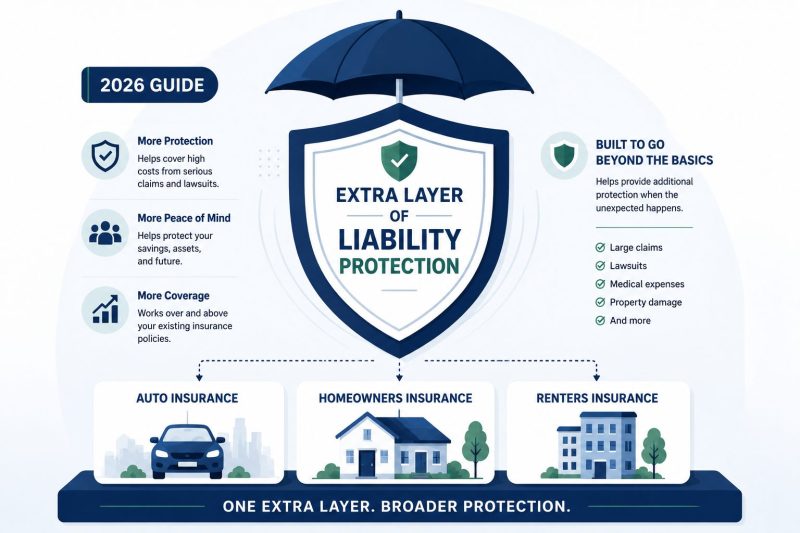
A Clear 2026 Guide to the Extra Layer of Liability Protection That Sits Above Your Auto, Home, and Renters Policies
Most California homeowners assume their auto and homeowners liability limits are enough to protect them if something serious happens. For the majority of everyday incidents, that assumption holds. But California’s combination of high property values, escalating medical costs, and a litigation environment that regularly produces judgments well beyond standard policy limits means that a single serious accident, a guest injury at your home, or an incident involving a teen driver can generate a claim that exceeds what your base policies are designed to pay. Personal umbrella insurance exists precisely to close that gap. This guide explains what an umbrella policy actually covers, what it deliberately excludes, who in California should seriously consider one, and what your existing policies need to look like before an umbrella can be added.
The core concept is simple, even though the coverage itself sounds abstract: an umbrella policy does not replace your auto or homeowners insurance. It sits on top of them, and it only activates once those underlying policies have paid out to their limit.
How Personal Umbrella Insurance Actually Works
A personal umbrella policy provides additional liability coverage above the limits of your existing auto, homeowners, renters, condo, or landlord insurance policies. If you are found legally responsible for an injury or property damage claim, your underlying policy pays first, up to its own limit. Once that limit is exhausted, the umbrella policy takes over and continues paying, up to the umbrella’s own coverage amount.
For example, if a serious auto accident generates a liability judgment that exceeds your auto policy’s liability limit, the umbrella policy covers the remaining amount rather than leaving you personally responsible for the difference. The same structure applies to a liability claim arising from an injury at your home, a dog bite, or another covered incident where the underlying policy’s limit is not sufficient to cover the full judgment.
Umbrella policies also frequently provide broader coverage than the underlying policies for certain claim types, including personal injury liability such as libel, slander, or false arrest, which many standard auto and homeowners policies limit significantly or exclude altogether. This makes the umbrella both a limit extender and, in some cases, a coverage broadener.
What an Umbrella Policy Does Not Cover
Understanding the exclusions is just as important as understanding the coverage, since umbrella policies are specifically designed as excess liability protection, not general-purpose coverage.
- Your own injuries or medical bills: An umbrella policy does not pay for your own medical costs if you are injured. It covers your liability to others, not your personal health or recovery costs.
- Damage to your own property: Your home, vehicle, and personal belongings remain the responsibility of your homeowners, auto, or renters policy. The umbrella does not extend property coverage.
- Intentional acts: If you are found to have caused harm or damage intentionally, umbrella insurance will not respond to that claim.
- Business-related liability: A personal umbrella policy excludes claims connected to business activity, including a home-based business. Business liability requires a separate commercial policy.
- Contract disputes: Umbrella insurance does not cover liability arising from a breach of a written or oral contract, such as a business or service agreement gone wrong.
These exclusions are not unusual or restrictive by industry standards. They reflect the umbrella’s specific purpose: extending liability protection for accidental injury and property damage claims to others, not serving as a catch-all policy for every financial risk a household faces.
Who in California Should Seriously Consider Umbrella Coverage
Umbrella insurance is not necessary for every California household, but several common situations meaningfully increase liability exposure and make the coverage worth evaluating seriously.
- Households with a teen driver: Teen drivers are statistically the highest-risk group behind the wheel, and a serious accident they cause can easily generate a liability claim that exceeds standard auto policy limits.
- Homeowners with a pool: Pools are considered an attractive nuisance in liability terms and are a common source of injury claims, particularly involving guests or neighborhood children.
- Households that frequently entertain: More guests on your property translate to more liability exposure, whether from a slip and fall, an alcohol-related incident, or another injury during a gathering.
- Landlords and rental property owners: A tenant or visitor injury on a rental property can generate a claim that exceeds your landlord policy’s liability limit, and an umbrella extends protection above it.
- Dog owners: Dog bite claims are a frequent source of homeowners’ and renters’ liability claims, and certain breeds or a prior bite history can increase this risk further.
- Anyone with meaningful assets: Home equity, savings, and investment accounts are all exposed to a court judgment if a liability claim exceeds your existing coverage. The greater your net worth, the more an umbrella policy protects.
For California homeowners specifically, umbrella coverage is often evaluated alongside a broader homeowners insurance review, particularly given how much the state’s property insurance market has shifted in recent years. If you have not reviewed your homeowners coverage recently, our comparison of the California FAIR Plan and private homeowners insurance is a useful companion resource, since your underlying homeowners policy structure directly affects what an umbrella can be built on top of.
What Your Underlying Policies Need to Look Like First
Umbrella carriers do not issue a policy in isolation. Nearly every insurer requires you to carry specific minimum liability limits on your underlying auto and homeowners or renters policies before an umbrella will attach. This requirement exists because insurers do not want the umbrella functioning as a backdoor way to buy a low-cost primary policy with high liability limits.
If your current auto or homeowners liability limits fall below what the umbrella carrier requires, you will need to raise those underlying limits first. In many cases, this is a modest additional cost on your existing policy, and it is a necessary step before the umbrella coverage can be added on top.
Our agents at Global Guard Insurance review a client’s full policy structure, auto, homeowners, or renters, and any additional properties, before recommending an umbrella amount, since the right coverage level depends on your total asset picture and the specific underlying limits each of your existing policies currently carries. Bundling all of these policies with carriers that coordinate well together also tends to simplify both the underwriting process and the eventual claims process if the umbrella is ever needed.
Frequently Asked Questions
What does personal umbrella insurance cover in California?
Personal umbrella insurance provides additional liability coverage above the limits of your existing auto, homeowners, renters, condo, or landlord policies. Once the liability limit on one of those underlying policies is exhausted by a claim, the umbrella policy takes over and continues paying up to its own limit. It covers bodily injury liability, property damage liability, and certain personal injury claims, such as libel or slander, that standard policies may limit or exclude.
What does personal umbrella insurance not cover in California?
Personal umbrella insurance does not cover your own injuries or medical bills, damage to your own property, intentional acts that cause harm, business-related liabilities, or claims arising from breach of a written or oral contract. It is strictly excess liability coverage for claims where you are legally responsible for injury or damage to someone else, sitting above your existing policies rather than replacing or duplicating their coverage.
Who needs personal umbrella insurance in California?
California residents with meaningful assets to protect, including home equity, savings, and investments, are the primary candidates for umbrella coverage, since a single serious liability judgment can exceed standard policy limits and put those assets at risk. Households with a teen driver, a swimming pool, frequent guests or entertaining, a rental property, or a dog are commonly advised to carry umbrella coverage because each of these situations meaningfully increases liability exposure beyond what a base auto or homeowners policy anticipates.
What underlying liability limits do I need before buying umbrella insurance in California?
Most California umbrella carriers require minimum liability limits on your underlying auto and homeowners or renters policies before they will issue a policy. If your current limits fall short of the carrier’s requirement, you will need to raise your underlying policy limits before the umbrella coverage can attach. Your agent can confirm the exact minimums required by the specific carrier being considered.
Does umbrella insurance cover rental property liability in California?
Yes, in most cases. If you own rental property in California, a personal umbrella policy can extend excess liability coverage above your landlord insurance policy, protecting you if a tenant or visitor is injured on the property and the claim exceeds your landlord policy’s liability limit. Confirm with your agent that your rental properties are specifically disclosed and included when the umbrella policy is set up. Contact Global Guard Insurance to review your full property and liability picture.
Is umbrella insurance expensive in California?
Personal umbrella insurance is widely considered one of the most cost-effective forms of coverage available, since it provides a large amount of additional liability protection relative to its premium, compared to raising the liability limits on underlying policies alone. Costs vary by household based on driving record, claims history, and risk factors such as teen drivers or a pool, and California has seen rising umbrella premiums in recent years due to escalating litigation trends and higher jury awards.
Does umbrella insurance cover a home-based business in California?
Generally, no. Standard personal umbrella insurance excludes liability arising from business activities, including a home-based business. If you operate any kind of business from your California home, you typically need a separate business liability policy or a specific endorsement to address that exposure, since your personal umbrella will not respond to a claim connected to business operations.
Protect Your California Assets With the Right Umbrella Coverage
A serious liability claim can exceed your policy limits faster than most California households expect. The licensed agents at Global Guard Insurance review your full policy structure and recommend the right umbrella coverage to protect what you have built. Call (800) 750-9115 or get your free California homeowners insurance quote today.