
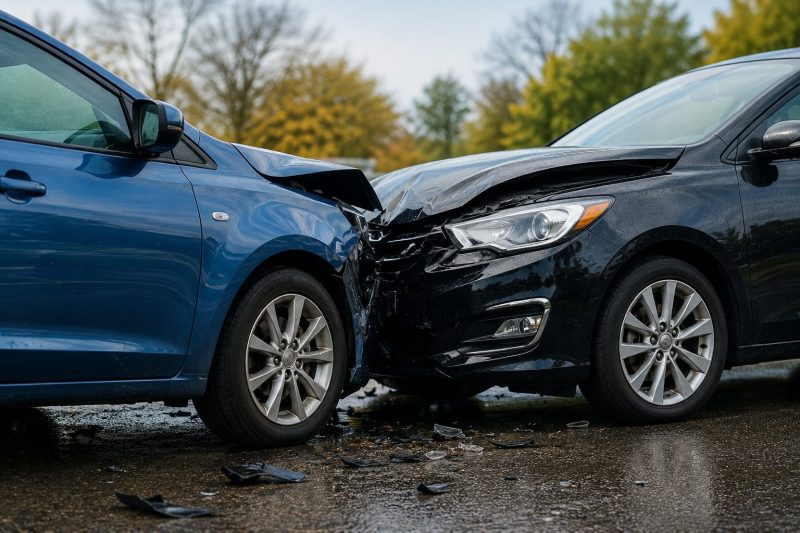
Most drivers know they need car insurance. Fewer understand exactly what happens when they actually have to use it. That gap in knowledge can lead to some unpleasant surprises after an accident, especially when a bill shows up that the driver didn't expect to pay.
Understanding your car insurance deductible before a claim happens isn't just helpful. It can make it much easier to choose car insurance coverage that fits both your budget and the amount of financial risk you're comfortable taking on.
The Basic Definition
A car insurance deductible is the amount you're responsible for paying toward a covered claim before your insurance pays its portion, subject to the terms of your policy.
Here's a simple example. A driver gets into a collision and the covered repair cost comes to $3,500. If the driver's collision deductible is $500, the driver would generally be responsible for $500 while insurance would cover the remaining eligible amount.
Deductibles don't necessarily apply to every type of auto insurance coverage. Liability coverage, for example, generally works differently because it is designed to help pay for covered injuries or property damage you cause to others.
Collision vs. Comprehensive Coverage
Collision coverage generally helps pay for covered damage to your vehicle resulting from a collision with another vehicle or object.
Think of situations such as backing into another vehicle in a parking lot, hitting a curb or being involved in a crash on the freeway.
Comprehensive auto insurance generally applies to certain losses that aren't caused by a collision. Depending on the policy, this can include events such as theft, vandalism and some types of weather-related damage.
Collision and comprehensive coverage can have separate deductibles. For example, a driver might choose a $500 collision deductible and a $250 comprehensive deductible.
The deductible that applies depends on the type of covered claim.
Common Car Insurance Deductible Amounts
The deductible options available depend on the insurer and policy. Drivers are often able to choose from several deductible amounts when purchasing comprehensive or collision coverage.
Rather than automatically choosing the lowest or highest option, think about how much you could realistically afford to pay unexpectedly after an accident, theft or other covered loss.
A deductible that looks attractive when you're buying the policy can feel very different when you actually have to pay it.
How Deductibles Can Affect Your Premium
Your deductible and insurance premium are connected.
Choosing a higher deductible generally means you're agreeing to take on more of the cost if you have a covered claim. In exchange, the premium for that coverage may be lower.
A lower deductible means you'll have less to pay toward a covered loss, but your premium may be higher.
Imagine two drivers with similar vehicles and driving histories. One chooses a $250 collision deductible while the other chooses $1,000. The first driver has less to pay after an eligible collision claim, while the second accepts more potential out-of-pocket expense in exchange for the possibility of a lower premium.
Neither option is automatically better. The right choice depends on your finances and how much risk you're comfortable assuming.
When Does a Deductible Not Apply?
You won't necessarily pay a deductible every time something happens involving your vehicle.
Liability coverage, for instance, doesn't typically use a deductible in the same way collision and comprehensive coverage do.
Claims involving another at-fault driver's insurance may also be handled differently than claims filed through your own collision coverage.
Other coverages can have their own rules as well. Uninsured and underinsured motorist coverage, for example, can vary based on the policy and state.
That's why it's important to review your actual policy instead of assuming the same deductible applies to every claim.
How to Choose the Right Car Insurance Deductible
Choosing an auto insurance deductible requires a little more thought than simply selecting the option with the lowest monthly premium.
Consider factors such as:
- Emergency savings: Could you comfortably pay your deductible tomorrow if something happened to your vehicle?
- Vehicle value: The age and value of your vehicle can affect whether carrying certain optional coverages makes financial sense.
- Driving habits: Think about how often and where you drive and the risks you regularly encounter.
- Local risks: Theft, severe weather and other risks can make comprehensive coverage especially important for some drivers.
- Monthly budget: Compare the potential premium difference against the additional amount you'd need to pay after a claim.
The goal is to find a balance between an affordable premium and a deductible you could actually handle if you needed to file a claim.
A Car Insurance Deductible Example
Imagine a driver parks outside overnight and discovers the next morning that someone broke into the vehicle and damaged a side mirror.
Suppose the covered damage costs $900 to repair and the driver's applicable comprehensive deductible is $500. The driver would generally be responsible for the first $500, with insurance potentially covering the remaining eligible $400.
Now imagine that same driver selected a $1,000 comprehensive deductible. Because the repair cost is less than the deductible, there may be no payment available under that coverage for the $900 loss.
That's the trade-off between higher and lower deductibles in action.
Look Beyond the Monthly Premium
It's easy to focus on price when shopping for auto insurance. But your monthly premium is only one part of the equation.
Coverage limits, deductibles, exclusions and the types of protection included in the policy all matter when you actually need to use your insurance.
Global Guard Insurance offers a range of auto insurance options, including collision, comprehensive, liability and other types of coverage. Comparing these options can help you understand what you're paying for rather than choosing a policy based on price alone.
Finding a Deductible That Works for You
A car insurance deductible might look like a small detail when you're comparing policies, but it can have a major impact when you need to file a claim.
The best deductible isn't necessarily the highest or the lowest. It's one that creates a reasonable balance between what you pay for coverage and what you could comfortably afford after an unexpected loss.
If you're comparing policies or aren't sure how your current deductible affects your coverage, contact Global Guard Insurance to discuss your options or request an auto insurance quote.
Know Exactly What Your California Renters Policy Covers
Wildfire is covered. Earthquake is not, unless you add it. The licensed agents at Global Guard Insurance can walk you through exactly what your renters policy includes and where the gaps are. Call (800) 750-9115 or get your free California renters insurance quote today.