What California’s First Major Auto Insurance Update in Over 50 Years Means for Your Policy in 2026
California drivers who renewed their auto insurance in early 2025 may have noticed something different on their declarations page. Senate Bill 1107, known as the Protect California Drivers Act, took effect on January 1, 2025, and raised the state’s minimum liability requirements for the first time since 1967. If you drive in California, this law applies to your policy. This post breaks down exactly what SB 1107 changed, why the old limits had become inadequate, how the new requirements work in a real accident situation, and what steps California drivers should take to confirm their coverage is genuinely sufficient.
Understanding this law matters beyond simple legal compliance. California’s roads carry more licensed drivers than any other state, and accidents here routinely involve complex claims across multiple parties. Knowing what your policy is required to cover, what it is not, and where your personal financial exposure begins is information every CA driver needs before they need it.
What California SB 1107 Changed
For nearly six decades, California required drivers to carry liability insurance at limits set when vehicles and medical care cost a fraction of what they do today. As real-world accident costs grew dramatically over the years, those minimums became increasingly insufficient for covering genuine losses. The California legislature recognized the gap and passed SB 1107 in 2022, with an effective date of January 1, 2025.
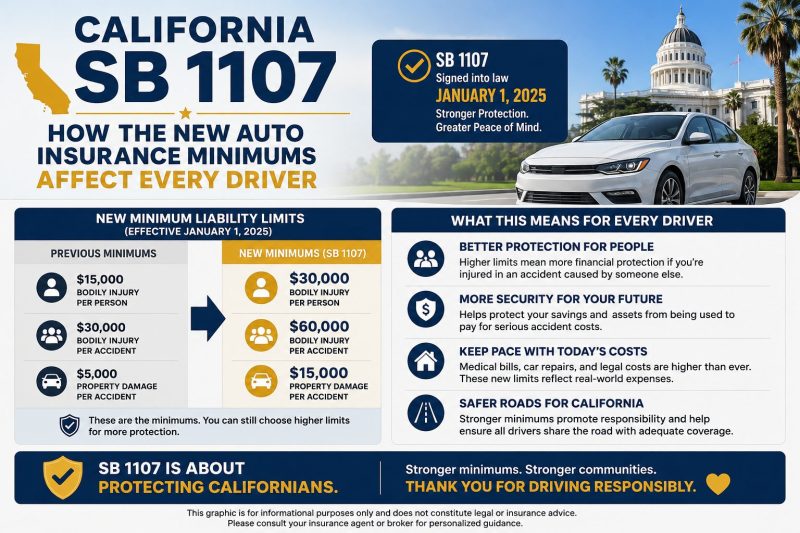
Under the revised Vehicle Code Section 16056, every California driver is now required to carry significantly higher minimum liability coverage than before. The law also raised the minimum uninsured and underinsured motorist (UM/UIM) coverage to match the new bodily injury requirements. These updated standards apply to private passenger vehicles, commercial vehicles, and recreational vehicles registered in California.
The current standard is not permanent. The same legislation schedules a further increase on January 1, 2035, when California’s minimum requirements will rise again to an even higher tier. The legislature built this escalation directly into the law to prevent the minimums from becoming outdated again over the following decade.
SB 1107 roughly doubled the previous bodily injury requirements and tripled the property damage requirement. A further increase is already written into the law for 2035, making this a phased approach to modernizing California’s minimum standards over time.
The Protect California Drivers Act was authored by Senator Bill Dodd and signed into law by Governor Gavin Newsom in September 2022. It was driven in large part by data showing that California ranked among the lowest states in the nation for minimum coverage adequacy. Injured parties were routinely finding that at-fault drivers met the legal requirement yet carried coverage that did not come close to covering actual medical costs and vehicle losses. SB 1107 was a direct legislative response to that gap.
What the New California Auto Insurance Minimums Actually Cover
Liability coverage pays for damage and injury you cause to other people. California’s new minimum requirements set the floor for what your insurer is required to pay on your behalf after an at-fault accident.
The minimum includes separate limits for bodily injury per person, total bodily injury per accident, and property damage per accident. Each category has a cap, and anything beyond that cap does not disappear. Under California law, an injured party may pursue a civil judgment against you personally for any amount that exceeds what your policy covers.
California places no ceiling on civil liability in personal injury cases. A serious multi-vehicle accident can generate losses well beyond what any minimum policy is designed to cover, which is why carrying only the legal minimum leaves drivers with significant personal financial exposure.
The minimum liability requirement also does not include collision coverage or comprehensive coverage for your own vehicle. Both remain optional under California law, though lenders and leasing companies typically require them as a condition of financing.
California drivers sometimes assume that meeting the minimum means they are fully covered in any situation. That assumption is incorrect. The minimum liability standard addresses only what you owe others after an at-fault accident. Your own vehicle damage, your own medical costs, and your own lost wages from injuries you sustain are not covered by liability insurance at any level. Those protections require separate coverage types, each of which serves a distinct purpose within a complete auto insurance policy.
How SB 1107 Affected Your Existing California Policy
Drivers who already carried liability limits above the previous state minimum saw no automatic change. Their coverage stayed the same and their premium was not adjusted solely because of this law.
For drivers who held only the old minimum, insurers were required to update the policy to meet the new requirements at the next renewal on or after January 1, 2025. The premium adjusted to reflect the higher coverage level, with the extent of any change depending on the carrier, the vehicle, and the driver’s history.
Our agents at Global Guard Insurance have worked with many California drivers who were unaware their limits had been updated until they reviewed their renewal documents. A common misconception we encounter is that a compliant policy and an adequate policy are the same thing. Meeting the legal minimum means you are allowed to drive in California. Whether that minimum actually protects your financial situation in a serious accident is a separate question entirely.
When you receive a renewal notice, the first step is to locate the liability limits on your declarations page and compare them against the new California requirements. If the limits reflect the current standard, your policy is compliant. The more important second step is to evaluate whether those limits are actually appropriate for your financial situation, your vehicle, and the level of risk you are willing to carry. A quick review with an independent agent can clarify both questions in a single conversation.
Is the State Minimum Sufficient for California Drivers?
The honest answer is that the state minimum satisfies a legal requirement. For most California drivers, it does not provide adequate financial protection.
A back injury from a moderate collision can generate medical bills, lost income, and rehabilitation costs that quickly outpace what a minimum liability policy is designed to cover. A total-loss claim on a newer vehicle can do the same. When claims exceed your policy limits, the difference does not disappear. The injured party has the right to pursue the remaining amount through California’s civil courts.
The UM/UIM component of SB 1107 deserves attention as well. California has one of the highest rates of uninsured drivers in the country, estimated at roughly 17 percent, according to the Insurance Research Council. UM/UIM coverage applies when the at-fault driver carries no insurance or insufficient coverage to pay your damages. Without it, an uninsured driver hitting you leaves you with no path to compensation through their policy.
Our agents at Global Guard Insurance generally recommend that CA drivers with any meaningful assets carry liability limits well above the legal minimum, alongside UM/UIM coverage and, where appropriate, an umbrella policy. As an independent agency, we compare options across multiple California carriers to find coverage levels that fit both your risk profile and your budget.
California drivers who are required to carry an SR-22 certificate of financial responsibility face an additional consideration. An SR-22 is typically required after a DUI conviction, a license suspension, or certain serious traffic violations. Under SB 1107, SR-22 policies must now meet the same updated minimum liability requirements as all other California auto policies. If your SR-22 was previously written at the old minimum, your insurer was required to update it at renewal. Drivers in this situation should confirm with their agent or carrier that their SR-22 filing reflects the current California requirements.
Frequently Asked Questions
When did California's new auto insurance minimums take effect?
California SB 1107 took effect on January 1, 2025. Any auto insurance policy issued or renewed in California on or after that date must meet the new, higher minimum liability requirements the law established. SB 1107 was signed in 2022 and given a delayed effective date to allow insurers and the California Department of Insurance sufficient time to prepare for the transition across all policy types and vehicle classes.
Will California auto insurance minimums increase again after 2025?
Yes. The same legislation schedules a second increase on January 1, 2035, raising California’s minimum liability requirements to an even higher tier. The legislature built this escalation directly into the law to prevent the standards from falling behind real-world costs again, as happened when the previous minimums went unchanged for nearly six decades before SB 1107 was enacted.
Does the new minimum cover damage to my own vehicle?
No. California’s minimum liability requirements cover only damage and injury you cause to others. Collision coverage, which pays for repairs to your own vehicle after an at-fault accident regardless of the other driver’s insurance status, and comprehensive coverage, which covers theft and non-collision events, are both optional under California law. To explore your full California auto insurance options, our licensed agents can walk you through coverage combinations that match your vehicle and driving situation.
Do the new minimums apply to uninsured motorist coverage as well?
Yes. SB 1107 also raised the minimum uninsured and underinsured motorist (UM/UIM) coverage to match the new bodily injury liability requirements. This is especially significant in California, where roughly 17 percent of drivers carry no insurance at all, according to the Insurance Research Council. UM/UIM coverage is your only recourse when the at-fault driver cannot pay for your injuries or vehicle damage.
If my policy already had higher limits than the previous minimum, did anything change for me?
No. SB 1107 established a new legal floor, not a ceiling. If your existing liability limits were already above the previous state minimum, your policy was unaffected by the new law. Only policies written at the old minimum were required to adjust upward at renewal. Drivers already carrying stronger coverage saw no automatic change to their protection or their premium as a direct result of this legislation.
Is the state minimum enough to protect my assets in California?
For most CA drivers with savings, property, or other assets, the state minimum provides legal compliance but not full financial protection. California places no cap on civil liability in personal injury cases. If your policy limits are exhausted after a serious accident, the injured party may pursue a judgment against your personal assets for the remaining amount. Our agents at Global Guard Insurance recommend liability limits well above the state minimum for anyone with meaningful assets to protect.
How does SB 1107 affect California drivers who are required to carry an SR-22?
SR-22 policies in California must now meet the same updated minimum liability requirements as all other auto policies in the state. If you are currently required to carry an SR-22 and your policy was previously written at the old minimum, your insurer was required to update your coverage at renewal to comply with SB 1107. Failing to maintain a compliant SR-22 can result in license suspension. To confirm your SR-22 meets current California requirements, speak with a licensed agent at Global Guard Insurance before your next renewal date.
Review Your California Auto Insurance Coverage Today
California’s updated minimum requirements are a step forward, but meeting the legal standard and having genuine financial protection are not the same thing. The licensed agents at Global Guard Insurance compare coverage options across multiple California carriers to find the right protection for your situation. Call us at (800) 750-9115 or get your free California auto insurance quote online today.